From defining collaboration, to representing emergent structure, to computing what becomes possible.
Rather than assuming a known organizational structure, I study how collaboration unfolds as agents interact, tasks are created and transformed, interdependencies emerge, and individual contributions become collectively consequential. My current work develops these ideas through LLM-based multi-agent systems.
What defines collaboration among intelligent entities, and what dynamics distinguish it from mere group behavior?
Representation
Expressiveness · adaptivity · scalability
How can emergent collaboration be represented without prescribing organization or scale?
Computation
Formal properties · evaluation · optimization
What can be derived, evaluated, and optimized once collaboration is represented, and at what computational cost?
Definition, representation, and computation
Definition
Interdependence, collective capability, and emergent dynamics
What defines collaboration among intelligent entities, and what dynamics distinguish it from mere group behavior?
Definition here does not mean fixing collaboration in advance. I ask which relational or structural objects make an interaction genuinely collaborative. Agents may not be the only—or even the most useful—objects: tasks, artifacts, obligations, evidence, and the relations among them may be equally fundamental. My earlier systems approached this question through the dependencies a task creates. The LLM-based digital twin brought heterogeneous human preferences into a shared control objective. Decentralized generative agents then made adaptive hierarchical knowledge-graph memory central: long-horizon cooperation depends on how each agent organizes multimodal experience and selectively shares relevant knowledge, not simply on retaining or transmitting more information. CUBE made interdependence unavoidable in the environment itself.
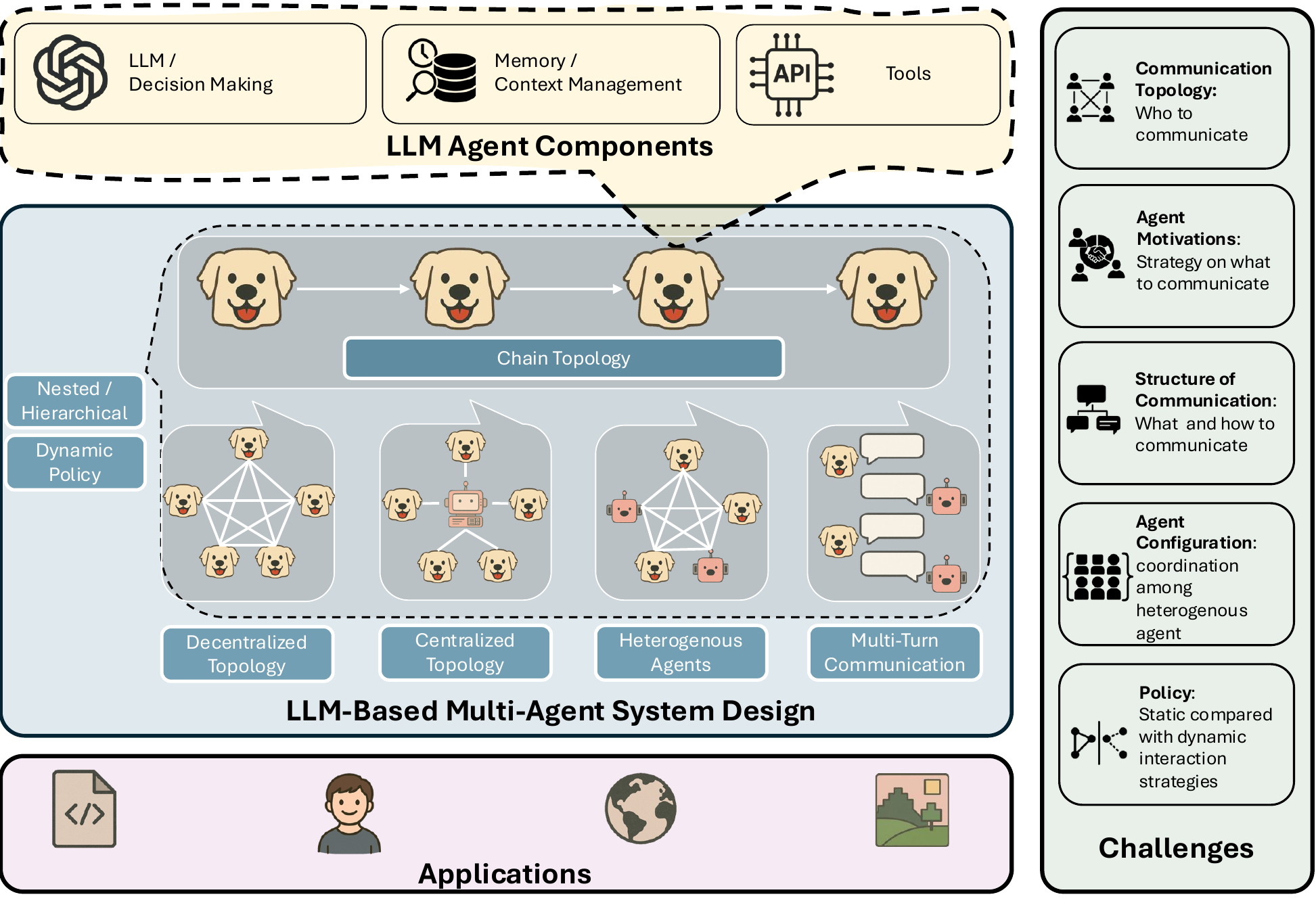
The Five Ws survey clarified a limitation running through much of multi-agent research: communication is often designed around a predefined objective or organization and then used as a proxy for collaboration. This shifted the question from how agents should communicate to what relational or structural conditions make their behavior genuinely collaborative in the first place.
Representation
Expressiveness, adaptivity, and scalability
How can emergent collaboration be represented without prescribing organization or scale?
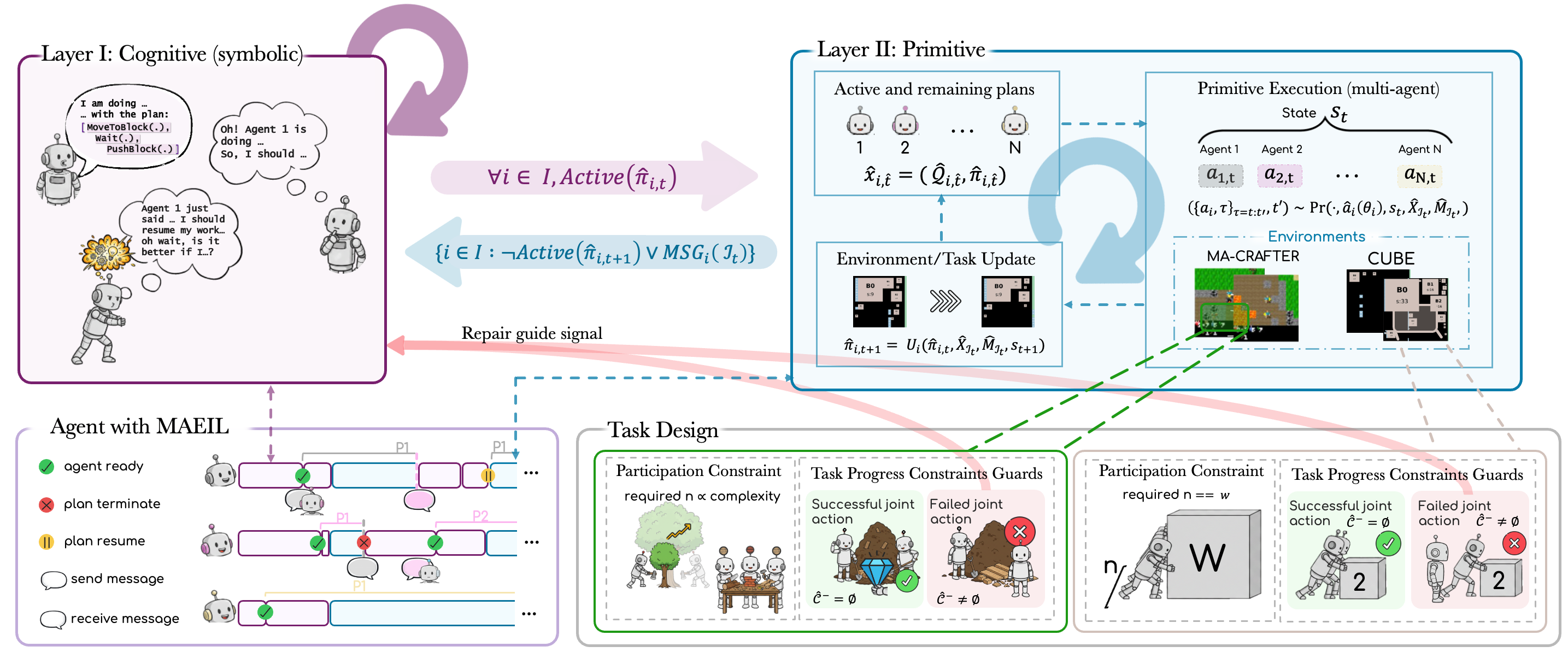
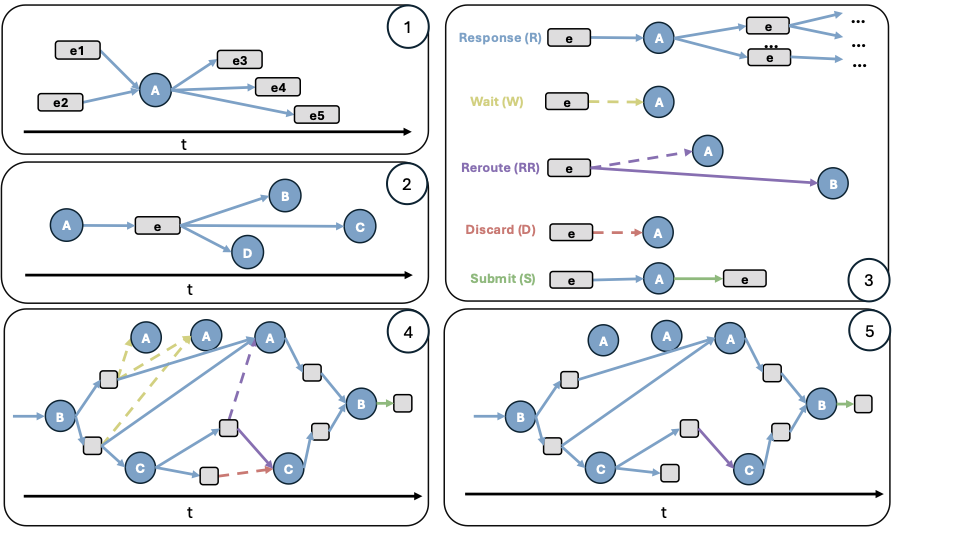
DIG began from the need to observe collaboration without fixing roles or workflows in advance. Its evolving event-activation graph preserves asynchronous decision paths and exposes structural failures, but a trace of what happened does not by itself say what work remains or who is responsible for it. COOP2 added grounding: it connects language-level plans and communication to task progress and explicit cooperative constraints.
iCORE takes the next step by representing observable interaction, evolving work, assignment, and evidence together as X = (G, Q, Π). The progression is from recording interaction, to grounding it in the task, to treating collaboration as an auditable relational object that can change with the task and the team rather than inherit a fixed organization. These representational distinctions also feed back into Definition: the need to represent work, assignment, and evidence shows why interaction alone is not the right primitive.
Computation
Formal properties, evaluation, and optimization
What can be derived, evaluated, and optimized once collaboration is represented, and at what computational cost?
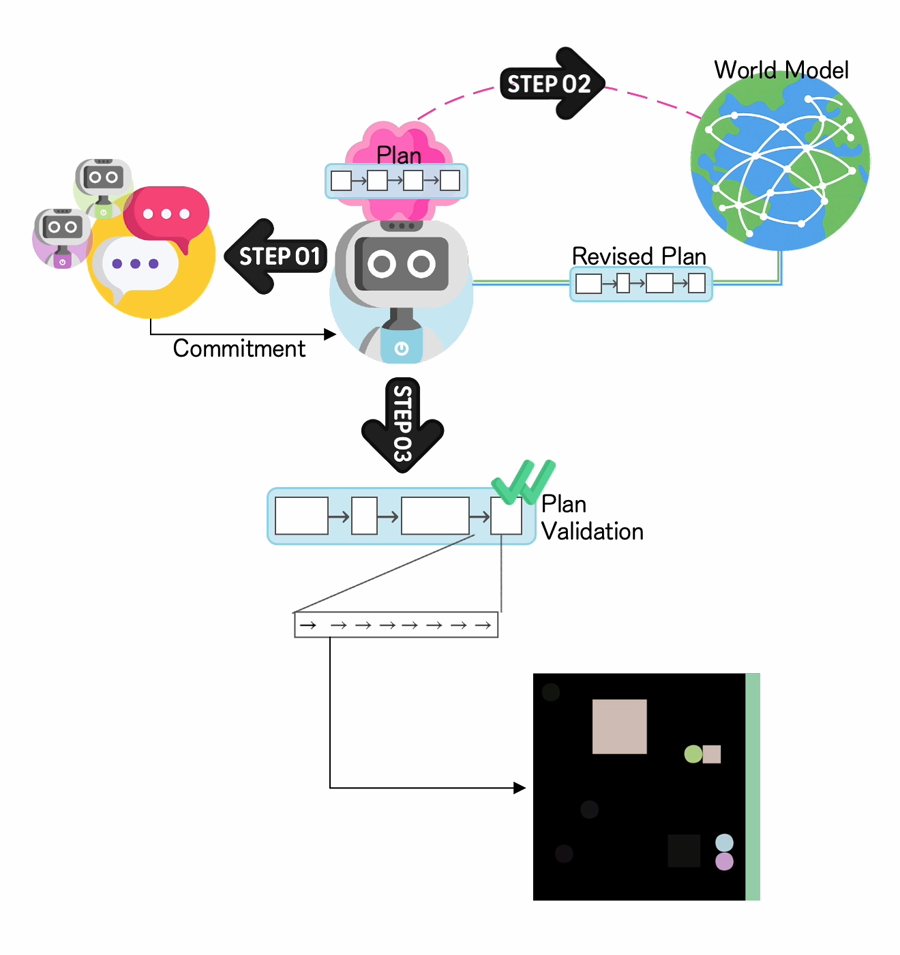
A representation becomes useful when it supports questions that final task success cannot answer. DIG turns recurring structural patterns into diagnostics for lost, duplicated, stalled, or prematurely terminated work. COOP2 moves from diagnosis to intervention by testing cooperative constraints and opening targeted repair when a plan is likely to fail.
iCORE moves further toward formal guarantees: it asks whether active work is soundly justified and whether assignments are stable, and connects local checks to global properties under stated conditions. Together these projects trace a progression from observing failure, to repairing it, to determining what can be certified or optimized—and when those computations remain tractable. Failed evaluations and guarantees feed back again, exposing what is missing from the representation and sharpening the definition of collaboration.
Research works
2026 · Preprint
Auditing Emergent LLM-Agent Collaboration through Cooperation-Obligation Coupling
Studies how observed interactions can be coupled with the work agents are responsible for and the evidence supporting each work-state transition. The resulting representation supports questions about soundness, responsibility, and assignment.
G interaction · Q obligation · Π evidence-backed coupling
2026 · Preprint
COOP2: Defining, Observing, and Repairing Cooperation in LLM Multi-Agent Systems
Connects natural-language plans and communication to grounded task progress. Cooperative constraints make it possible to examine where a group fails to progress and whether targeted revision helps.
DIG to Heal: Scaling General-purpose Agent Collaboration via Explainable Dynamic Decision Paths
Represents asynchronous multi-agent execution as a time-evolving graph of agent activations and events. The graph is used to locate structural patterns associated with lost, duplicated, stalled, or prematurely terminated work.
The Five Ws of Multi-Agent Communication: A Survey from MARL to Emergent Language and LLMs
Organizes multi-agent communication around who communicates with whom, when, what, and why. The survey shows how collaboration is often operationalized through developer-specified objectives or organization rather than treated as a first-class phenomenon.
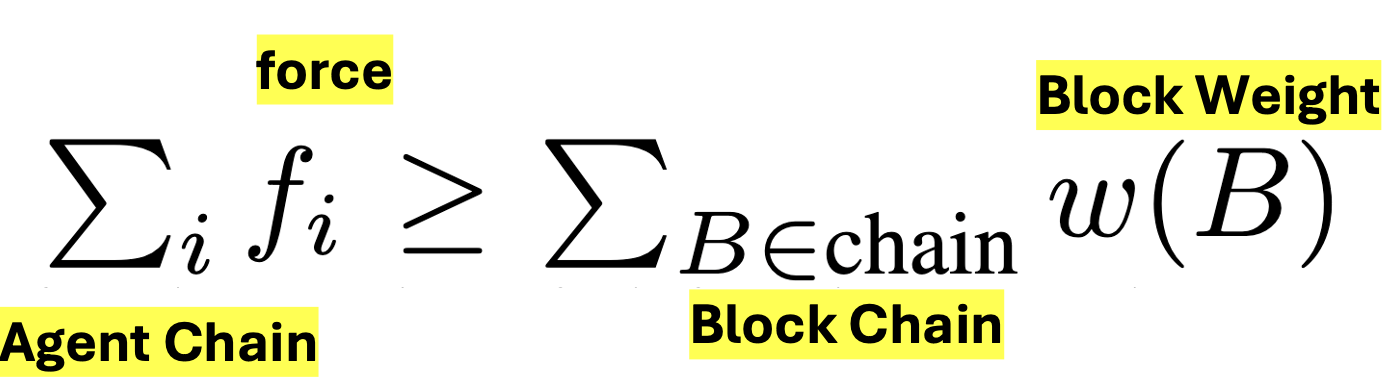
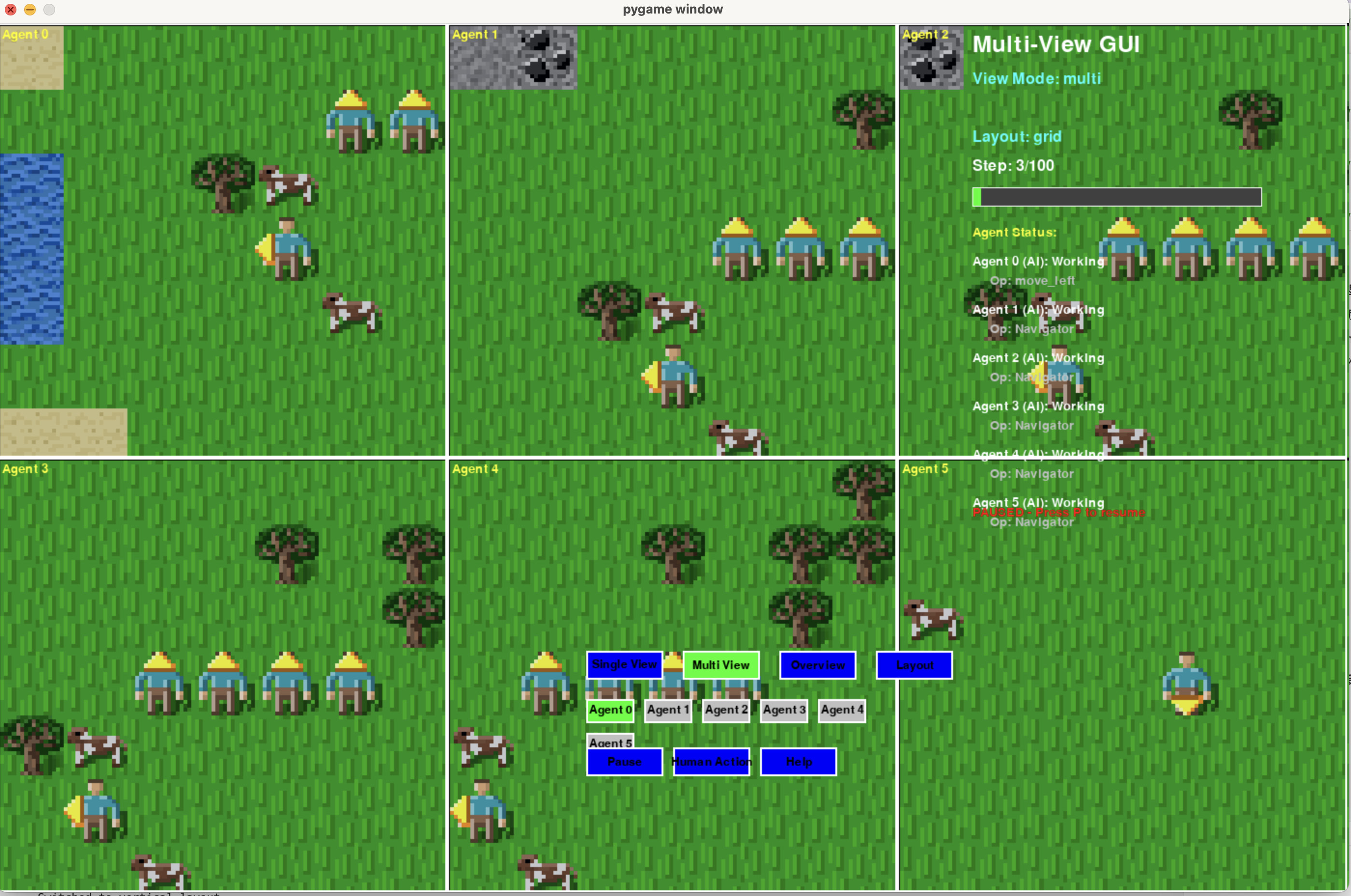
A lightweight environment in which weighted blocks, force, congestion, collisions, and timing create explicit dependencies among agents. It provides symbolic and primitive interfaces for studying collective planning.
Decentralized Generative Agents for Cooperative Planning
Introduces DAMCS, with adaptive hierarchical knowledge-graph memory as its central mechanism. The memory organizes multimodal experience across levels so decentralized agents can reason from past interactions, while structured communication lets them share relevant knowledge rather than entire histories during long-horizon planning.
An LLM-Based Digital Twin for Optimizing Human-in-the-Loop Systems
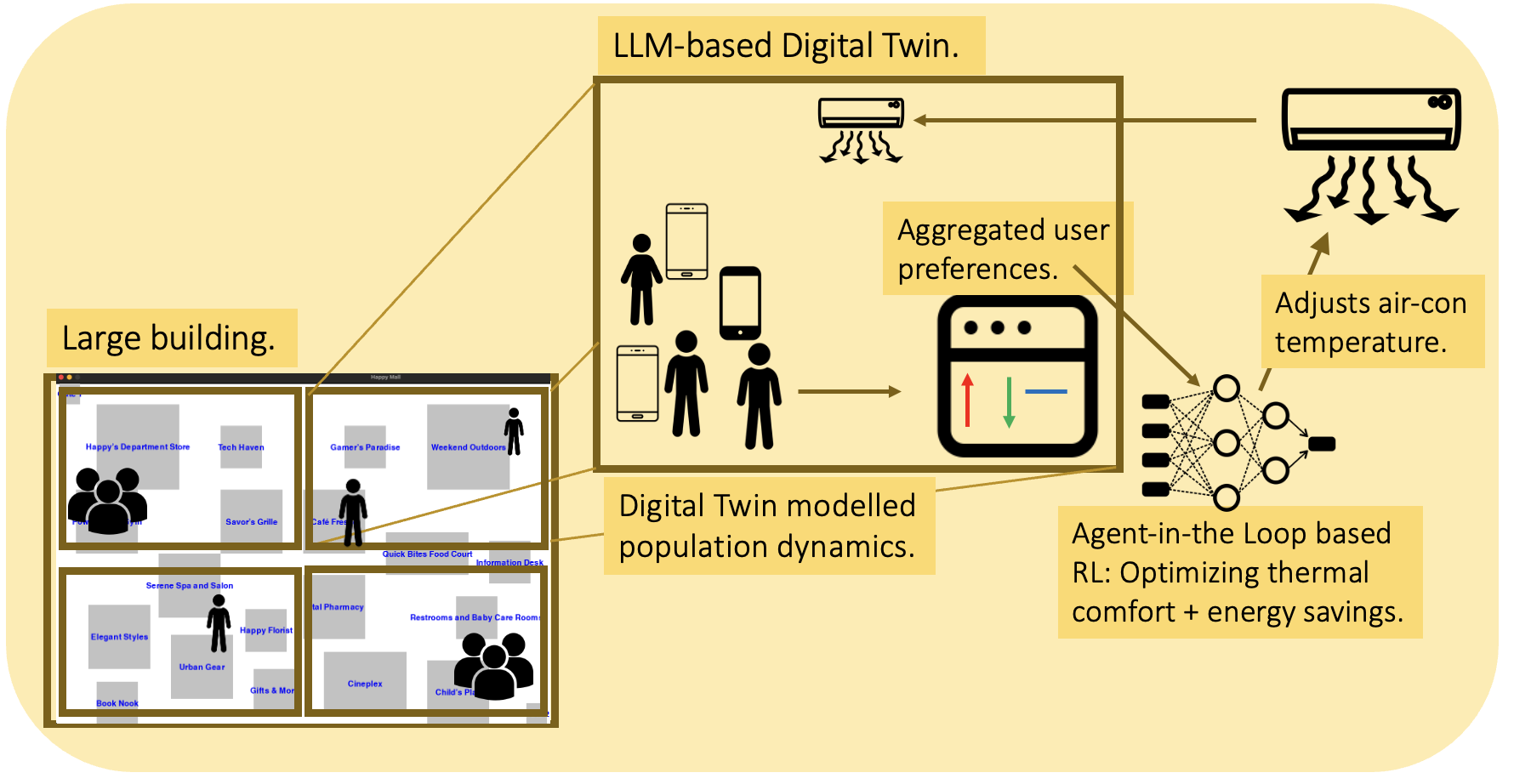
Uses an LLM-based digital twin to simulate heterogeneous human feedback for adaptive HVAC control, with collective occupant preferences encoded in the learning objective.