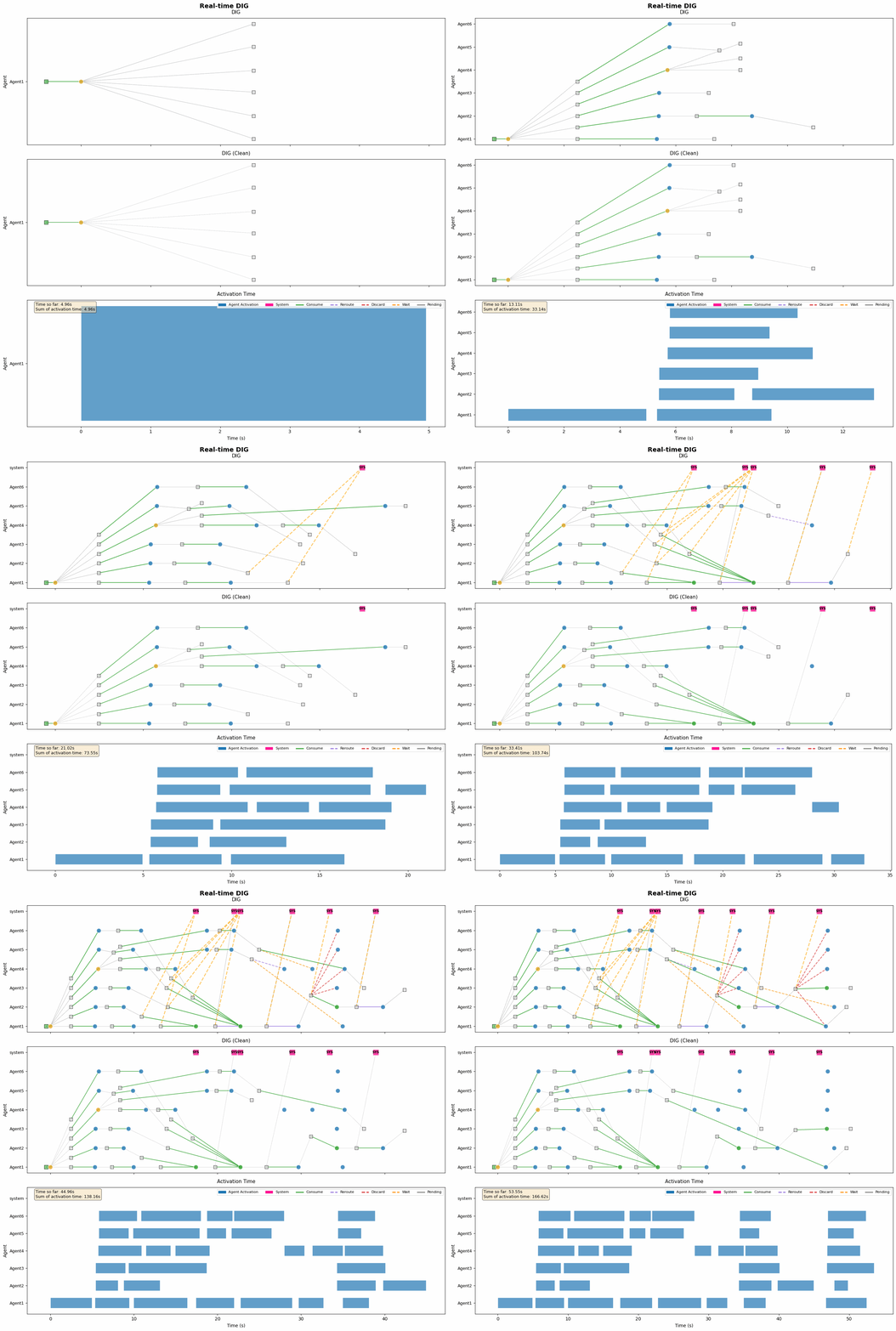
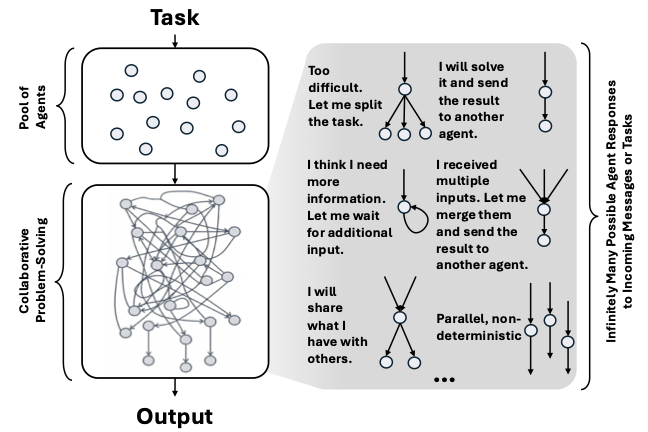
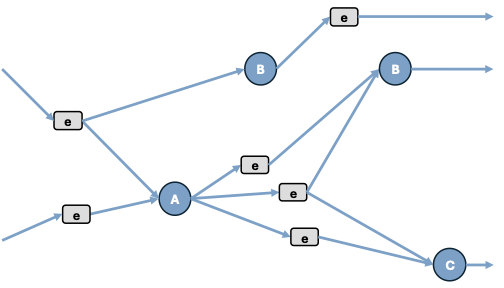
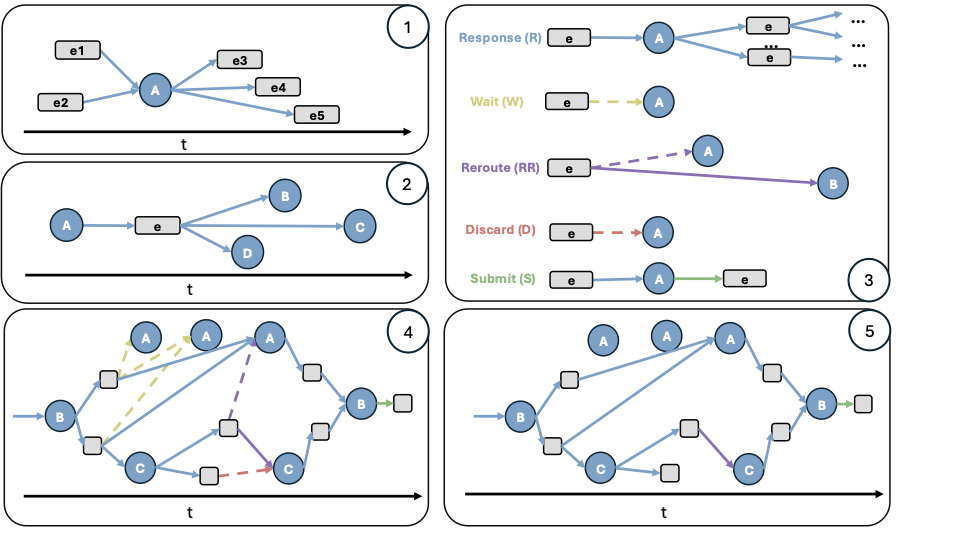
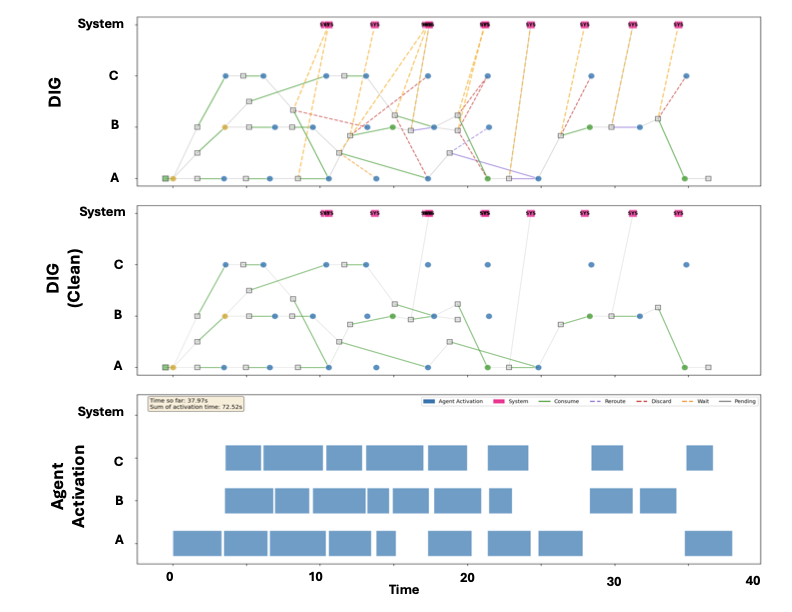
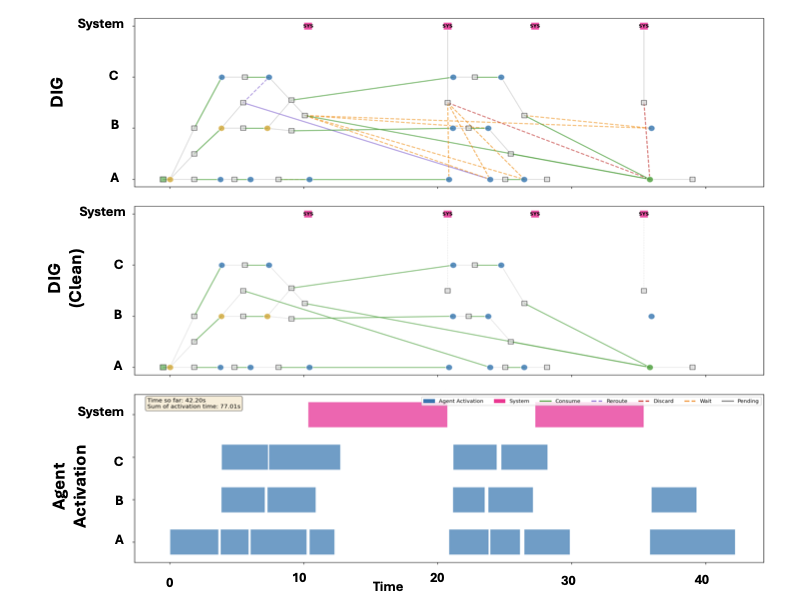
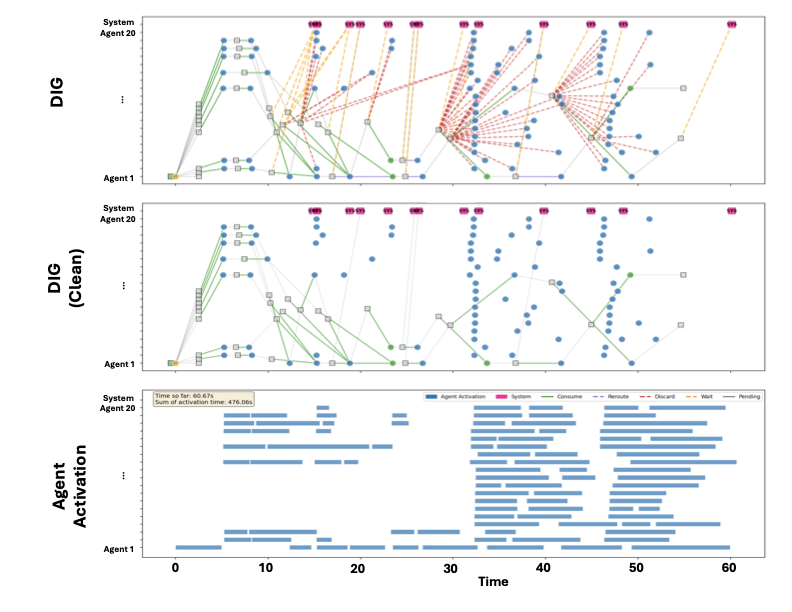
DIG provides a structural basis for expressing task-solving processes in asynchronous, general-purpose LLM agents:
activation nodes preserve input–output associations, event nodes preserve information identity, and input labels specify
how each recipient handles an event. On top of this structure we read a simplified task state
$X(t) = [\,U(t) \mid C(t)\,]$, where $U(t)$ and $C(t)$ count unfinished and completed contributions. Columns identify tasks;
rows distinguish copies of a task. The initial state is one unfinished task, $X(0) = [\,1 \mid 0\,]$.
Every interaction primitive has a local effect on $X(t)$. Delivery: one recipient leaves $X(t)$ unchanged,
several recipients replace the row with one copy per recipient, no recipient removes it.
Input labels: Wait and Reroute leave $X(t)$ unchanged, Discard removes the row,
and the effect of Consume depends on the activation's outputs: expansion ($n > m$) splits work into new rows and
subtask columns, reduction ($n < m$) sums rows column by column, and transformation ($n = m$) moves counts from $U$ to $C$.
For a task requiring each piece exactly once, we hope to end with one short row, $[\,0,\dots,0 \mid 1,\dots,1\,]$.
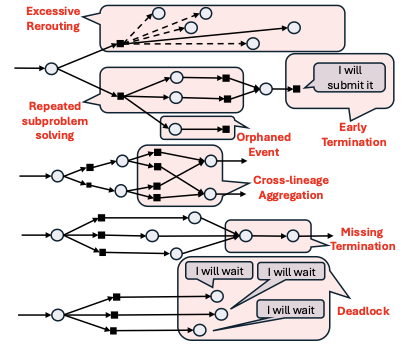
Departures from that shape are what the failure patterns below are built on: extra rows mean work was never merged,
counts left in $U$ mean unfinished work, counts above one in $C$ mean repeated information, and extra columns mean more splits than needed.