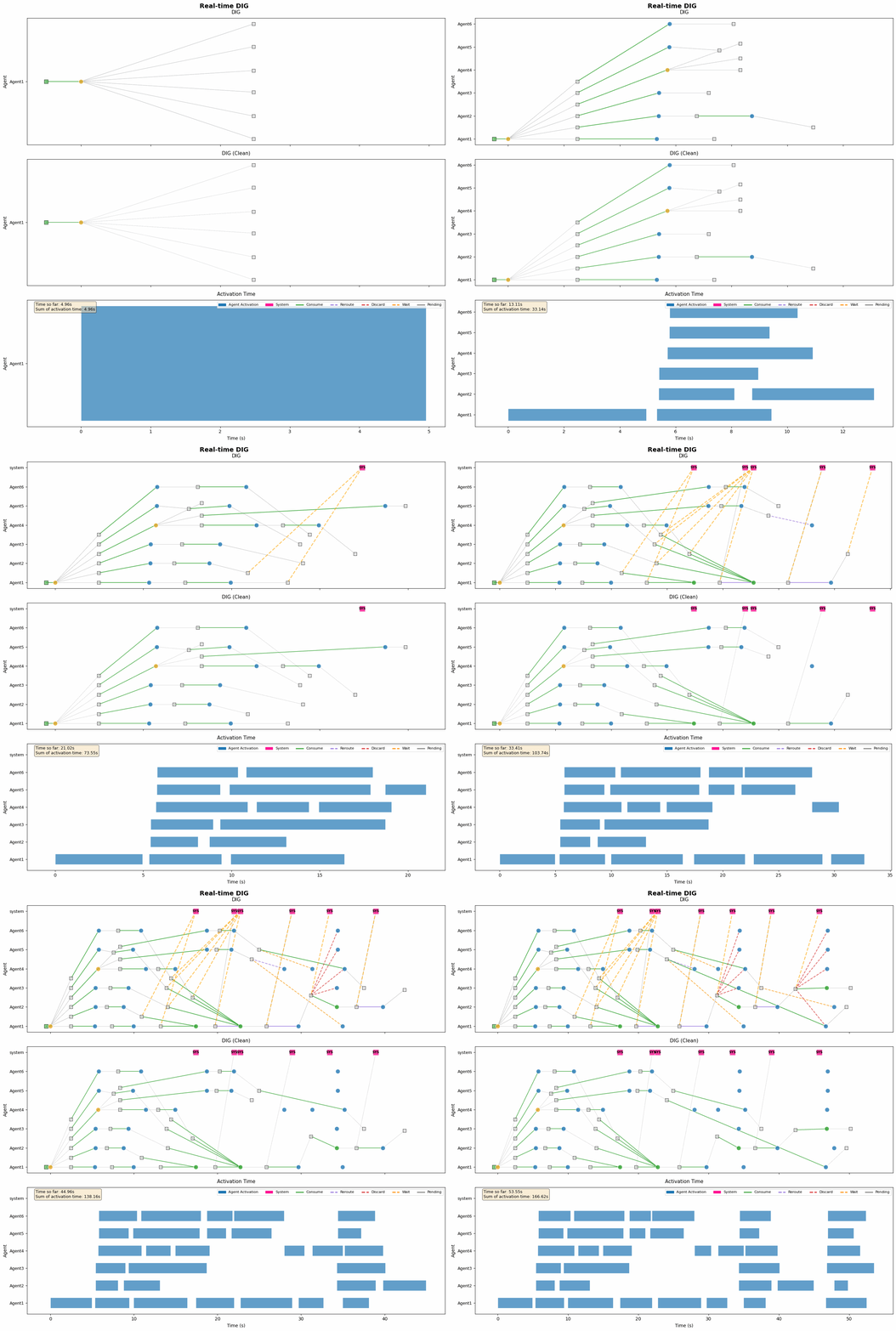
Results
We evaluate DIG on two verifiable task structures with agent capability constraints:
Count Frequency (CF), a fully parallelizable task, and Research Job (RJ),
a dependency-constrained task with staged processing and merging.
Results report detected structural failures, final task error, and runtime, with mean +/- standard deviation over
10 runs. We compare MAS-Only with MAS+DIG, and use MAS+LLM Judge as a qualitative
baseline for real-time intervention overhead.
83%
CF error reduction in the homogeneous 6-agent, load-6000 setting.
33%
CF error reduction in the heterogeneous 6-agent, load-222222 setting.
44%
RJ error reduction in the homogeneous dependency-constrained setting.
20
Agent case study completed with DIG after MAS-Only failed within 120 s.
Count Frequency: Parallelizable Tasks with Capability Constraints
DIG consistently reduces final error across CF settings. Although CF is parallelizable, each agent has a
capability limit, so larger loads must be decomposed and assigned across agents. The improvement is largest
when coordination is harder: more agents, larger loads, or heterogeneous capabilities create more opportunities
for incomplete coverage, redundant work, and premature submission.
| Setting |
Method |
Agents |
Load |
# Failure |
Error |
Time (s) |
| Homogeneous agents, capability 1000 |
| MAS-Only | 4 | 4000 | 2.11 +/- 0.31 | 0.083 +/- 0.118 | 13.0 +/- 9.1 |
| Error -70% | MAS+DIG | 4 | 4000 | 2.60 +/- 1.80 | 0.025 +/- 0.075 | 10.7 +/- 7.8 |
| MAS-Only | 4 | 8000 | 2.60 +/- 0.66 | 0.688 +/- 0.084 | 14.3 +/- 8.4 |
| Error -15% | MAS+DIG | 4 | 8000 | 9.10 +/- 1.45 | 0.588 +/- 0.138 | 20.1 +/- 9.4 |
| MAS-Only | 6 | 6000 | 2.50 +/- 1.50 | 0.100 +/- 0.249 | 9.2 +/- 1.0 |
| Error -83% | MAS+DIG | 6 | 6000 | 2.60 +/- 1.80 | 0.017 +/- 0.050 | 10.4 +/- 2.8 |
| MAS-Only | 6 | 12000 | 3.50 +/- 1.03 | 0.850 +/- 0.033 | 19.4 +/- 12.7 |
| Error -9% | MAS+DIG | 6 | 12000 | 8.80 +/- 0.98 | 0.775 +/- 0.065 | 19.7 +/- 9.1 |
| Heterogeneous agents, capabilities [..., 1000, 100, 10, 1] |
| MAS-Only | 4 | 1111 | 1.80 +/- 0.40 | 0.000 +/- 0.000 | 8.9 +/- 0.9 |
| Error approx. 0 | MAS+DIG | 4 | 1111 | 2.50 +/- 1.86 | 0.001 +/- 0.003 | 9.4 +/- 2.5 |
| MAS-Only | 4 | 2222 | 2.60 +/- 0.80 | 0.735 +/- 0.266 | 33.0 +/- 7.9 |
| Error -27% | MAS+DIG | 4 | 2222 | 8.60 +/- 1.63 | 0.533 +/- 0.357 | 42.9 +/- 8.6 |
| MAS-Only | 6 | 111111 | 2.10 +/- 0.30 | 0.100 +/- 0.268 | 12.2 +/- 8.1 |
| Error -8% | MAS+DIG | 6 | 111111 | 5.30 +/- 3.49 | 0.092 +/- 0.209 | 16.8 +/- 9.4 |
| MAS-Only | 6 | 222222 | 2.70 +/- 1.10 | 0.847 +/- 0.279 | 32.5 +/- 13.2 |
| Error -33% | MAS+DIG | 6 | 222222 | 10.10 +/- 1.64 | 0.568 +/- 0.372 | 43.8 +/- 11.0 |
Research Job: Dependency and Capability Constraints
RJ adds staged dependencies on top of capability constraints, so errors can arise from invalid processing,
invalid merging, overloaded assignment, and dependency violations. DIG catches these structural failures before
they propagate to later stages.
| Setting |
Method |
# Failure |
Error |
Time (s) |
| Homogeneous agents, stage load 4000 |
| MAS-Only | 6.20 +/- 2.96 | 0.50 +/- 0.30 | 24.8 +/- 31.8 |
| Error -44% | MAS+DIG | 8.40 +/- 1.69 | 0.28 +/- 0.28 | 17.9 +/- 2.2 |
| Heterogeneous agents, stage load 1111 |
| MAS-Only | 3.50 +/- 1.43 | 0.55 +/- 0.15 | 43.4 +/- 32.9 |
| Error -18% | MAS+DIG | 8.70 +/- 1.85 | 0.45 +/- 0.15 | 68.6 +/- 26.7 |
The apparent increase in detected failures is expected: DIG keeps execution active long enough to expose and
repair failures that MAS-Only may leave unresolved. Runtime can increase for the same reason, although RJ
homogeneous runs show that structure-driven repair can also reduce wall-clock time by preventing wasted work.
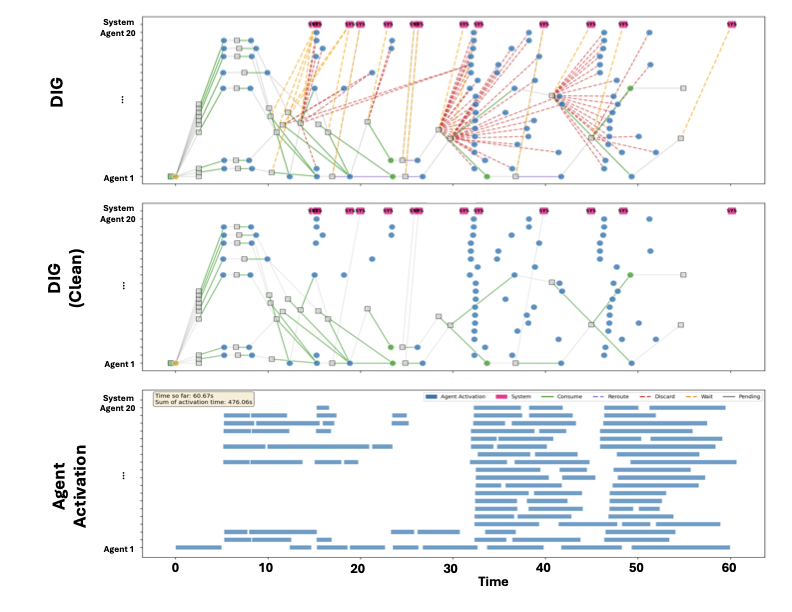
Case study: 20-agent scale.
On CF with load 100,000, MAS-Only fails to produce a result within 120 s. With DIG, the same 20-agent system
produces a valid answer within 70 s using 92 calls. During the run, DIG detects 1 missing completion error,
8 repeated-effort incidents, 2 dependency warnings, 1 orphaned event, and 4 early termination errors. This
highlights that adding agents alone does not guarantee reliable collaboration; the interaction structure itself
needs real-time monitoring and repair.