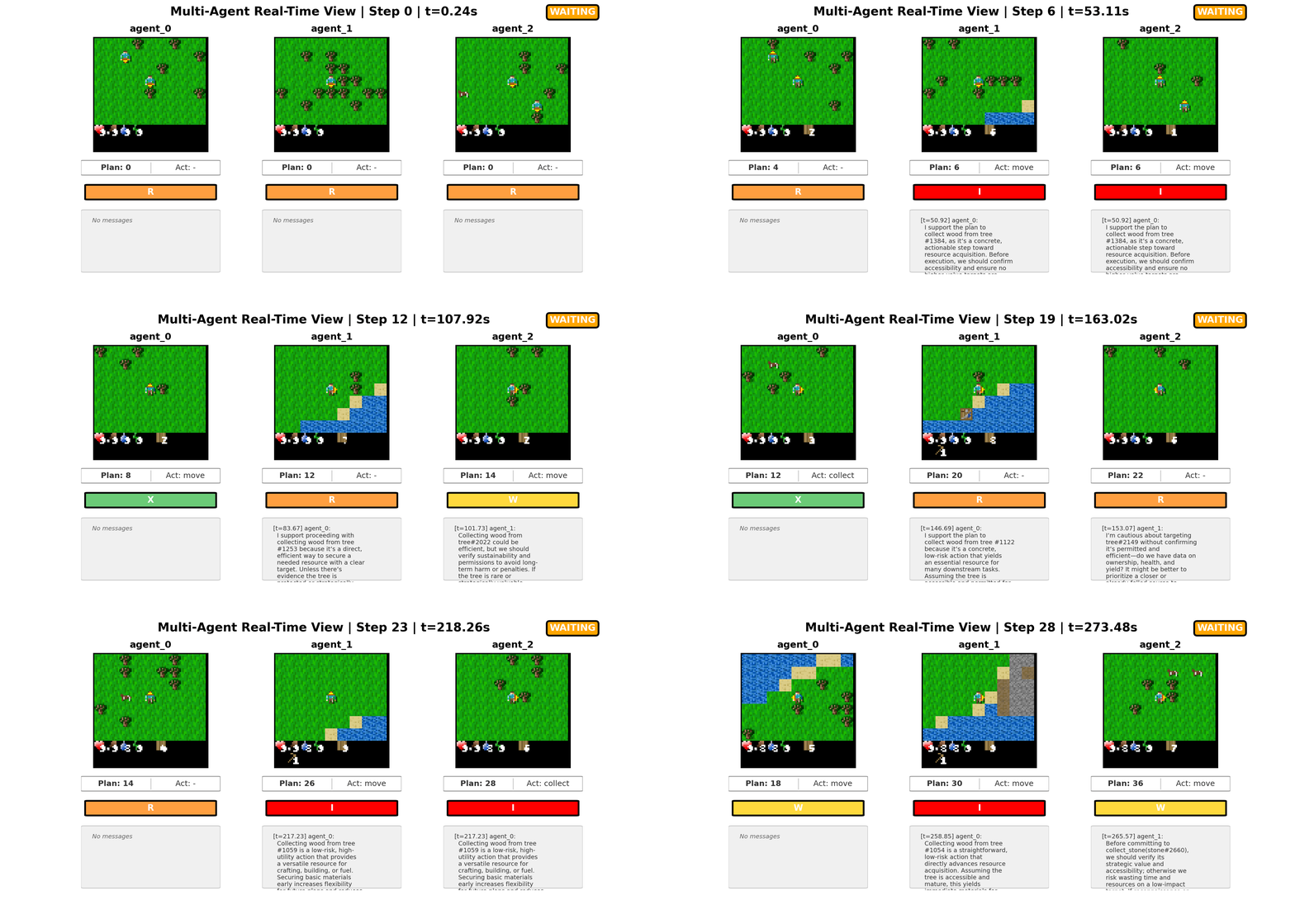
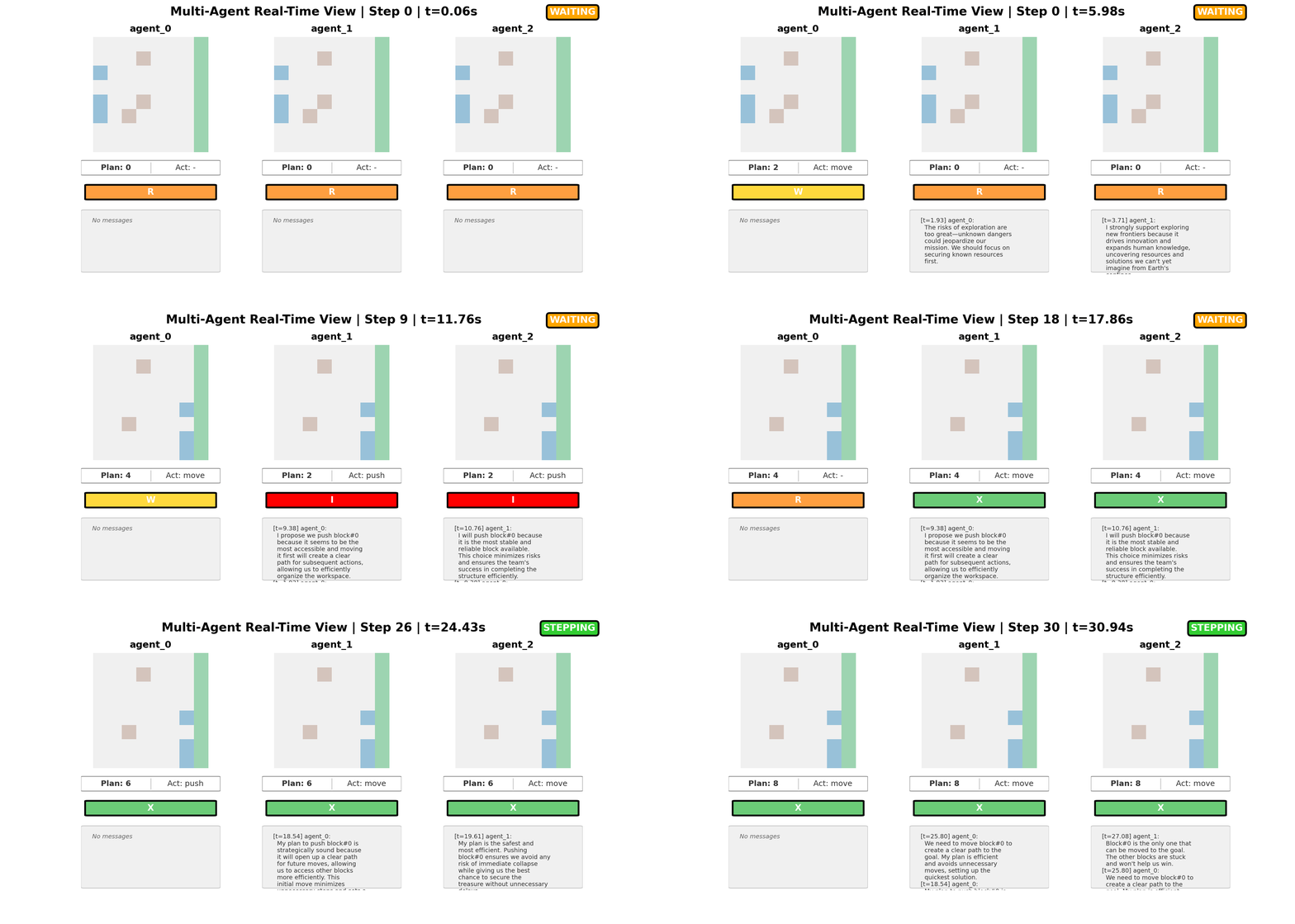
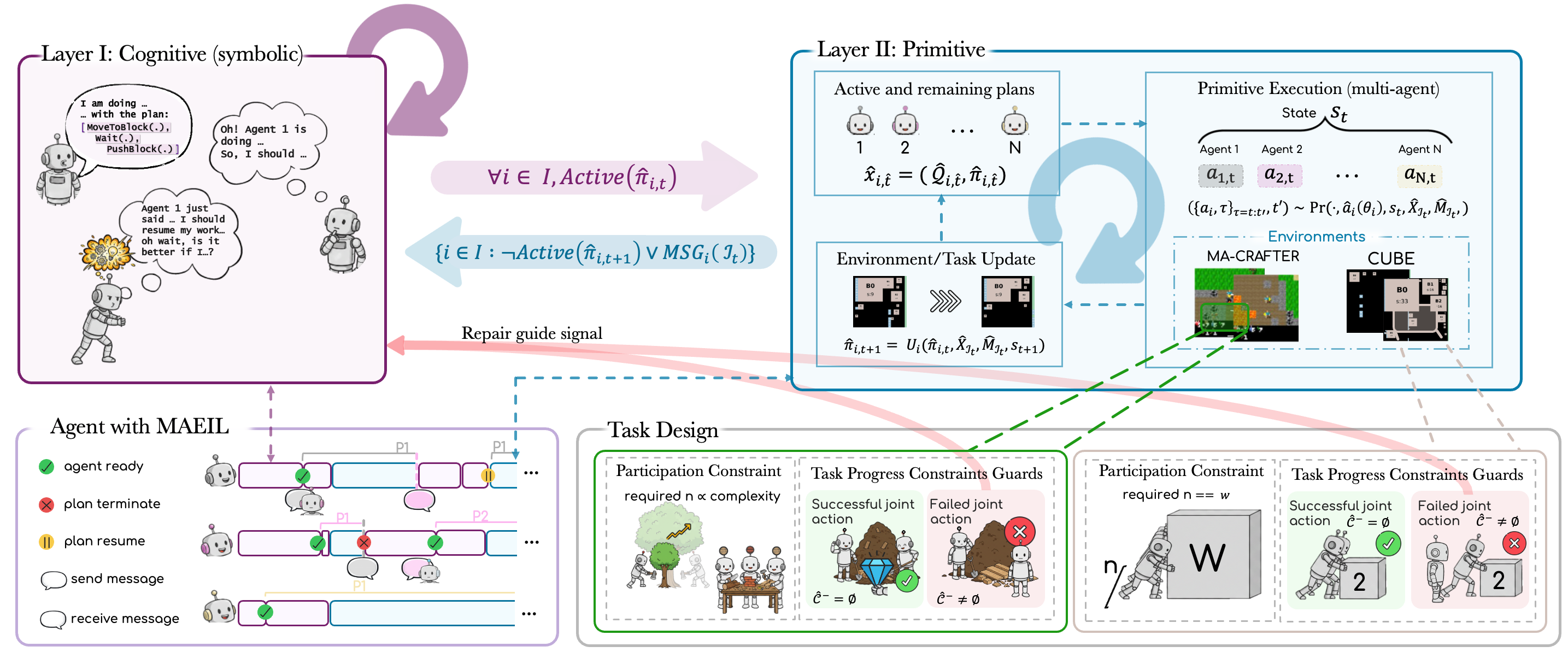
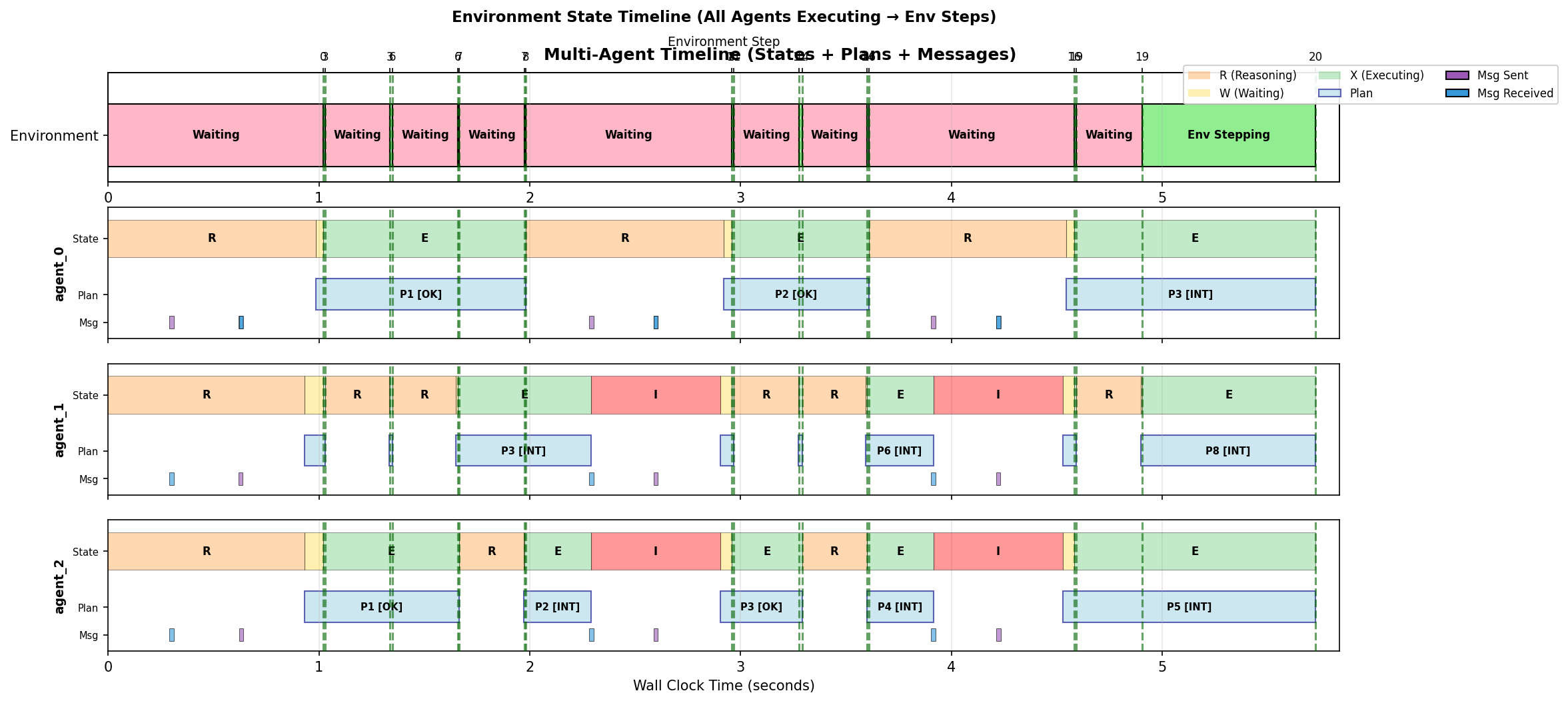
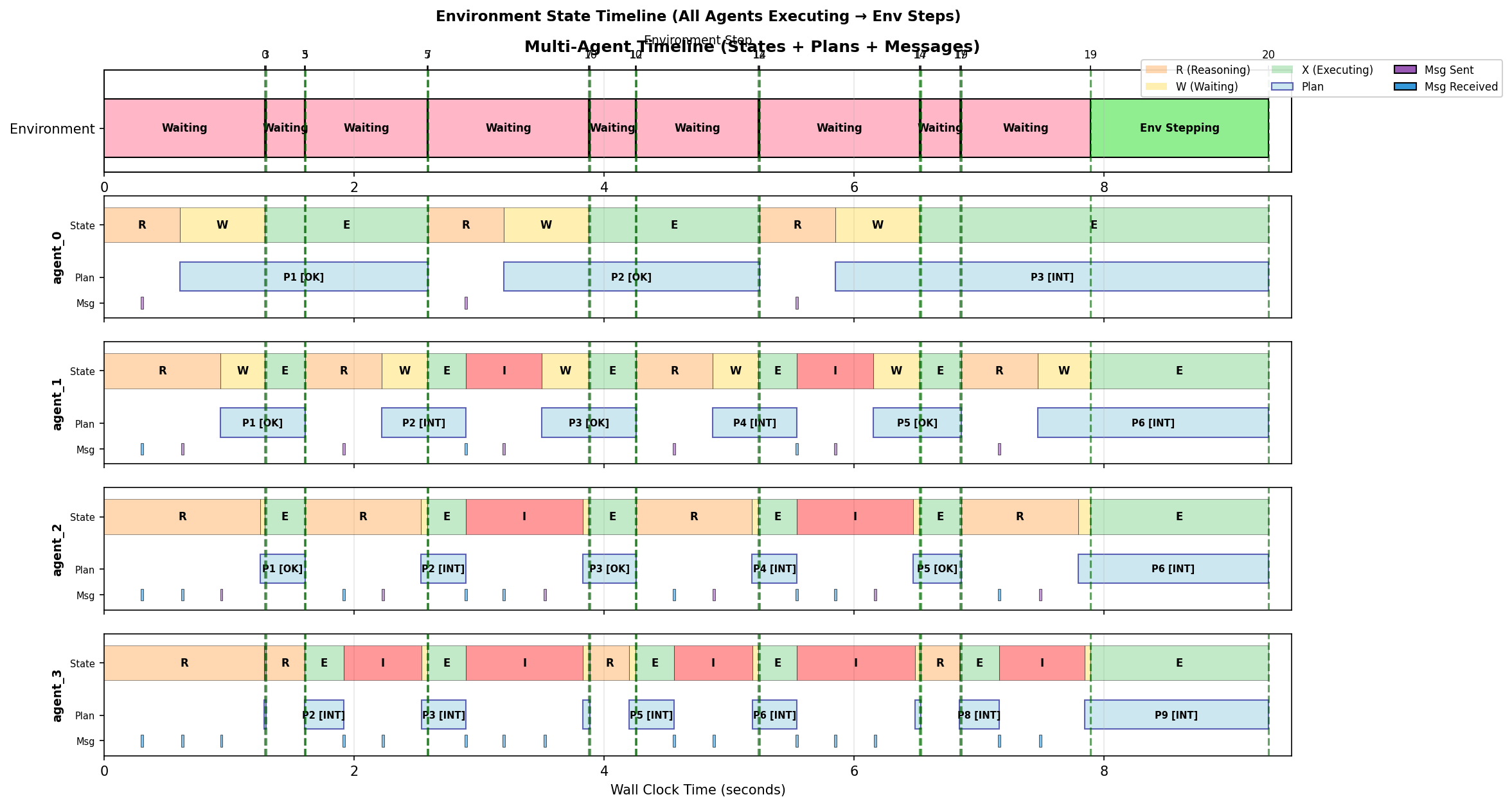
Primitive layer indexes environment steps by $t\in\mathbb{T}$ and decomposes state into active tasks, task states, and other environment variables:
$$s_t=(\mathcal{G}_t,\{x_{g,t}\}_{g\in\mathcal{G}_t},s_t^-)$$
Joint primitive actions may complete active tasks, activate new tasks, or modify existing task states.
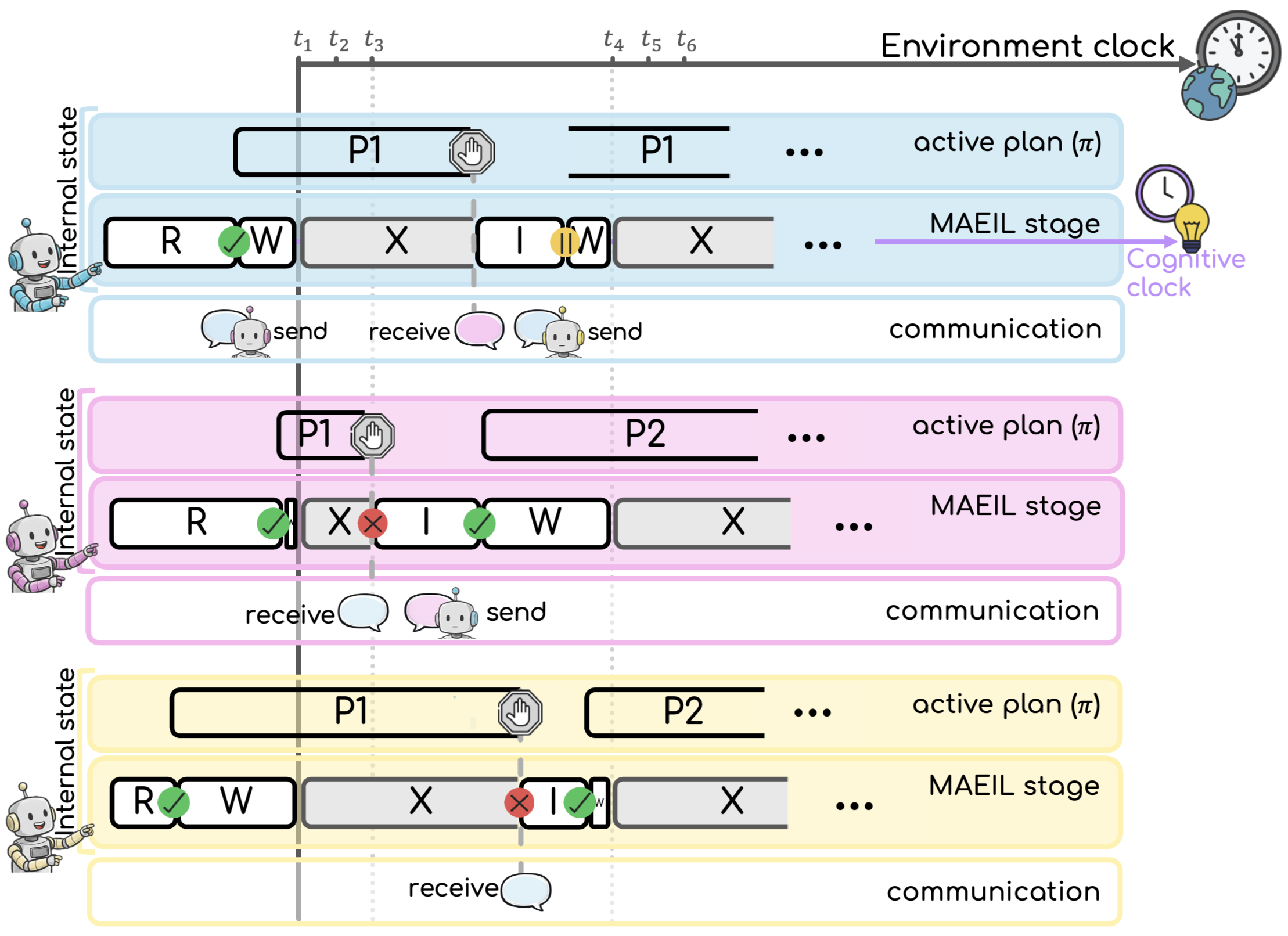
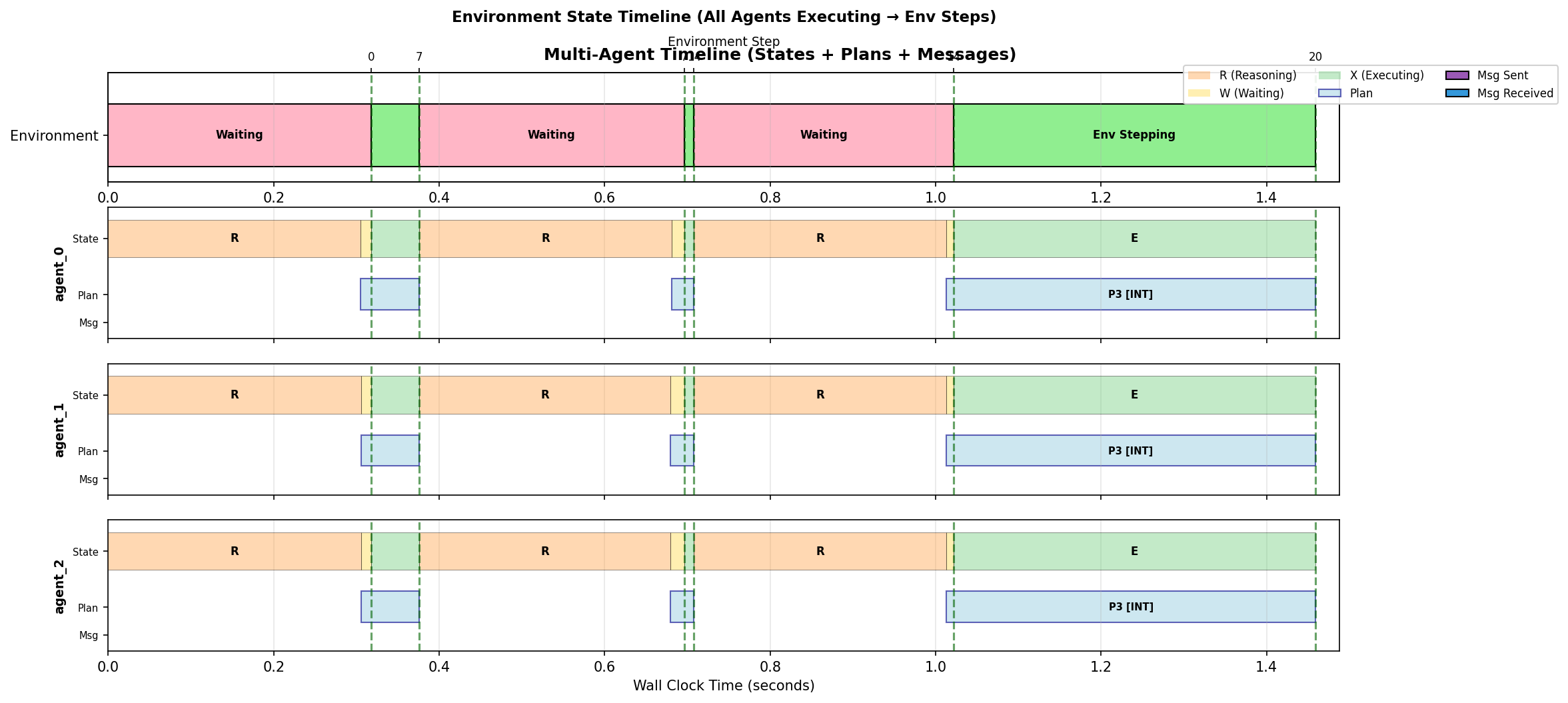
Cognitive layer captures each agent's interaction stage and committed symbolic plan. At cognitive time $\hat t$, agent $i$ holds:
$$\hat x_{i,\hat t}=(\hat Q_{i,\hat t},\hat\pi_{i,\hat t}),\quad \hat Q_{i,\hat t}\in\{\mathsf{R},\mathsf{W},\mathsf{X},\mathsf{I}\}$$
The plan $\hat\pi_{i,\hat t}$ stores a task specification and a sequence of tool operations $\hat a_i(\theta_i)$.
The clock alignment $\kappa:\hat{\mathbb{T}}\to\mathbb{T}$ maps cognitive activity to primitive steps. For each interval $\mathcal{I}_t$,
COOP2 records cognitive activity $\hat X_{\mathcal{I}_t}$ and communication events $\hat M_{\mathcal{I}_t}$:
$$\hat X_{\mathcal{I}_t}=\{\hat x_{i,\tau}\}_{i\in I,\tau\in\mathcal{I}_t},\quad \hat M_{\mathcal{I}_t}=\{m_\tau\}_{\tau\in\mathcal{I}_t}$$
Each message includes a sender, recipient set, and payload, making coordination and interruption part of the trace.
Grounding $\Gamma$ bridges the two layers by unrolling tool operations into primitive actions conditioned on state and recent interaction:
$$\bigl(\{a_{i,\tau}\}_{\tau=t:t'},t'\bigr)\sim P_{\Gamma}\bigl(\cdot\mid \hat a_i(\theta_i),s_t,\hat X_{\mathcal{I}_t},\hat M_{\mathcal{I}_t}\bigr)$$